Most people lose money in crypto not because the market beat them, but because they never controlled their assets in the first place. Module 1 of the Ultimate DeFi Course starts where it matters most: self-custody and the trading tactics that actually move the needle. You'll learn exactly how to hold your own assets without relying on exchanges, third parties, or anyone who can freeze, lose, or mismanage your funds. That's not a small thing. That's the foundation everything else is built on.
4 Ratings & 4 Reviews
When your assets are fully under your control, you’re not exposed to exchange collapses, withdrawal locks, or counterparty risk. You’re operating in Web3 the way it was designed — where you are the bank, and no one can touch your stack without your say-so. The trading tactics in this module are built around that reality, so every move you make comes from a position of strength, not dependency.
And the tactics themselves? These aren’t recycled basics. They’re cutting-edge trading calls and strategies designed to give you a real, actionable edge in today’s market. You’ll walk away knowing how to read setups, time entries with precision, and build a profit plan that accounts for where you’re going — not just where you are now. Combined with a self-custodial foundation, you’re not just learning to trade. You’re learning to trade safely, on your own terms.
This is the starting point for financial freedom that doesn’t depend on anyone else’s infrastructure. If you’re serious about building wealth through DeFi yields, staking rewards, and early project alpha, this is where it begins. Enroll in the Ultimate DeFi Course and take control from day one.
If you’ve been trading on Binance, Coinbase, or even the stock market, you already know how to think about entries, exits, and risk. But self-custodial trading is a different game, and it starts with you controlling your own assets, your own keys, and your own outcomes. No broker. No exchange holding your funds. No one between you and your money.
This is where I start every student, because getting this foundation wrong makes everything else harder.
Self-custodial trading means trading crypto directly from a wallet you own and control without a centralized exchange (CEX) acting as the intermediary. Your private keys are yours. Your assets stay on-chain. You execute trades, manage positions, and capture DeFi yields without giving custody to any third party. It’s the foundation of everything DeFi makes possible.
What you’ll be able to do after this module: Set up and secure a self-custodial wallet with confidence: no technical background needed
If you’re coming from a CEX or a brokerage, you’re not starting from zero; you’re upgrading. And once you trade self-custodially for the first time and feel what it means to have real ownership, going back feels impossible.
Your module workbook and cheat sheet walk you through every setup step so you’re not guessing. And if something doesn’t click, message me directly on Telegram. I’ll help you work through it personally.
This module doesn’t just teach you how DeFi works — it puts you inside it, in control, from day one.
Most people hear “DeFi” and think it just means crypto trading without a bank. It’s much bigger than that. Decentralized finance is an entirely parallel financial system: one that runs on code, operates 24/7, and doesn’t require your permission slip from anyone.
I’ve been in DeFi from the very beginning. And the single biggest shift I’ve seen in students who really get it is this: they stop asking “how do I use this protocol” and start asking “how do I build wealth with this system.” That’s what this module is about.
What is decentralized finance (DeFi)?
Decentralized finance refers to financial services and protocols built on public blockchains — primarily Ethereum and other smart contract platforms — that operate without centralized intermediaries like banks, brokers, or exchanges. DeFi protocols enable lending, borrowing, trading, yield farming, and liquidity provision through transparent, automated smart contracts. Anyone with an internet connection and a self-custodial wallet can participate.
What you’ll be able to do after this module:
If you’re coming from traditional finance or a centralized exchange, this module reframes everything you already know. Your instincts around markets, risk, and returns still apply, but the infrastructure has changed fundamentally. And once you understand it at this level, you start seeing the opportunities that most people walk straight past.
The module workbook gives you a structured reference you’ll come back to again and again. And I’m available on Telegram DM whenever you want to go deeper on anything here: no queue, no waiting, just direct access.
Understand DeFi at this level, and you stop being a tourist in someone else’s financial system — you start operating in your own.
Web3 isn’t a buzzword. It’s the architecture that makes self-custodial trading, DeFi yields, and true digital ownership possible. And if you want to move serious money through decentralized protocols, you need to understand the environment you’re operating in.
I’ll show you exactly how I think about Web3 as an infrastructure layer: not as hype, but as the rails everything else runs on.
What is Web3?
Web3 refers to the third generation of the internet, built on decentralized blockchain infrastructure. Unlike Web2 — where platforms like banks, social networks, and exchanges own your data and assets — Web3 gives users direct ownership and control through cryptographic keys, smart contracts, and decentralized protocols. For traders and investors, Web3 is the environment where self-custodial trading, DeFi, NFTs, and on-chain financial activity happen.
What you’ll be able to do after this module:
This is the context that makes everything downstream make sense. Students who skip the foundations and jump straight to strategies tend to make expensive mistakes. I built this module so you don’t have to learn those lessons the hard way.
The cheat sheet for this module is one of the most-used resources students pull out throughout the whole course. And when you’re exploring a new chain or protocol and want a second opinion, message me on Telegram. I’ll give you my honest take.
Web3 is where financial freedom is being built right now — this module makes sure you can operate in it without second-guessing yourself.
Staking is one of the most powerful passive income strategies in crypto, and one of the most misunderstood. Most people either stake on a CEX without realizing what they’ve given up, or they avoid it entirely because the mechanics seem too complex.
I’ll show you exactly how I approach blockchain-native staking: on-chain, self-custodial, and without handing your assets to a third party.
What is blockchain-native staking?
Blockchain-native staking is the process of locking crypto assets directly in a blockchain’s proof-of-stake consensus mechanism or in a DeFi protocol to earn staking rewards. Unlike CEX staking, blockchain-native staking is done from your own self-custodial wallet. You retain ownership of your assets throughout the process. Staking rewards are generated directly by the network or protocol and distributed on-chain.
What you’ll be able to do after this module:
If you’ve been staking on Binance or Coinbase, you’re earning a fraction of the real yield, and you don’t actually own the staked assets. This module shows you what you’re leaving on the table and how to take it back.
The module workbook includes a staking strategy framework you can apply immediately. And if you’ve found a specific staking opportunity you want me to look at before you commit capital, message me directly on Telegram. I’ll give you my honest read on whether it’s worth it.
This module turns staking from a passive concept into an active part of your wealth-building strategy — on your terms, under your control.
The difference between struggling in DeFi and operating confidently often comes down to your tools. The right setup tells you where the alpha is, flags risks before they cost you, and automates the repetitive work so you can focus on decisions that matter.
After 10+ years in crypto, here’s the tech stack I’ve actually settled on and why.
What are DeFi trading tools and tech stacks?
A DeFi tech stack is the collection of tools, platforms, and protocols a trader uses to research, execute, and manage on-chain positions. This typically includes on-chain analytics platforms, portfolio trackers, DEX aggregators, smart contract auditing tools, and gas optimization utilities. The right stack lets you trade with more information, less friction, and significantly reduced exposure to scams and rug pulls.
What you’ll be able to do after this module:
You don’t need 20 tools. You need the right ones, configured correctly, working together. This module cuts through the noise and gives you exactly that.
The module cheat sheet is a quick-reference guide to every tool I cover. Save it, use it, share it. And if you want me to look at a specific platform you’ve been considering, drop me a message on Telegram. I’ve probably already tested it.
Build the right setup once and it pays you back every single time you open a trade.
This is where theory becomes money. Advanced DeFi strategy isn’t about being the smartest person in the room. It’s about having a repeatable system, knowing your exit before you enter, and executing without emotion.
I’ll walk you through the exact frameworks I use to build positions in DeFi, from liquidity farming and yield optimization to identifying early projects with real upside before the crowd finds them.
What is advanced DeFi strategy?
Advanced DeFi strategy encompasses the tactical decision-making layer that separates systematic DeFi traders from reactive ones. It includes position sizing, liquidity farming optimization, yield strategy construction, early project identification, exit strategy planning, and risk management across multi-protocol exposure. It’s the integration of everything you’ve learned into a coherent, executable profit plan.
What you’ll be able to do after this module:
If you’re an experienced stock or CEX trader, this module will feel like coming home, but with more levers to pull and no broker taking a cut. The frameworks are familiar. The upside is not.
This is also where personalised DM support becomes most valuable. Bring me a specific trade idea, a project you’re sizing up, or a position you want to stress-test. I’ll work through it with you directly on Telegram, one-on-one, no gatekeeping.
A strategy without a system is just hope — this module gives you the system
On-chain analysis is the closest thing to an edge in crypto. While most traders react to price, on-chain analysts read the actual movement of funds, wallet behavior, and protocol activity and position ahead of it.
This is what I wish I’d known when I started. And it’s one of the most consistent sources of alpha I’ve used over the last decade.
What is on-chain analysis?
On-chain analysis is the practice of examining blockchain transaction data — wallet activity, token flows, smart contract interactions, liquidity movements, and holder behavior — to make informed trading and investment decisions. Because public blockchains are transparent and immutable, on-chain data reveals what’s actually happening in a market, not just what price is doing. It’s a core tool for identifying early project momentum, detecting exit signals, and avoiding manipulation.
What you’ll be able to do after this module:
This module pulls back the curtain on how I actually find trades: not from Twitter calls or Discord alpha groups, but from what the blockchain itself is telling me. It’s a skill that compounds over time. The more you use it, the better your read becomes.
The workbook for this module includes annotated analysis examples and a repeatable on-chain research checklist. And if you’re looking at a specific project and want me to run analysis alongside you, message me on Telegram. This is exactly the kind of thing I do with students one-on-one.
The blockchain doesn’t lie — this module teaches you how to read it.
NFTs got buried under the noise of the last cycle. But underneath the hype and the cartoon JPEGs, there’s a fundamentally new model of digital ownership and some of the most interesting financial mechanics in Web3.
I’ll show you exactly how I think about NFTs as part of a broader DeFi strategy: not as collectibles, but as assets with utility, liquidity, and real on-chain value.
What are NFTs in a DeFi context?
Non-fungible tokens (NFTs) are unique, verifiable digital assets recorded on a blockchain. In a DeFi context, NFTs represent provable ownership of digital and real-world assets — including art, gaming assets, real estate, and protocol positions. Advanced NFT ecosystems integrate with DeFi protocols to enable fractional ownership, NFT-backed lending, liquidity provision, and yield generation. They are not inherently speculative; they are a new ownership primitive.
What you’ll be able to do after this module:
This module is for anyone who dismissed NFTs as degen noise and walked away from one of the most active sectors in Web3. Done right, NFT strategy is on-chain analysis, project research, and exit planning — the same skills you’re building everywhere else in this course.
The cheat sheet here covers the key evaluation criteria I use before touching any NFT project. And if you’re considering a specific project and want a second opinion, message me directly on Telegram. I’ll tell you what I actually think.
NFTs aren’t a trend to watch from the sidelines — they’re a market to participate in strategically.
You came into this course looking for a way to build real wealth in DeFi without relying on banks, brokers, or anyone else to do it for you. And over these nine modules, you’ve built something most people never get: a complete, working understanding of how decentralized finance actually operates, and exactly how to use it.
But here’s what I want you to know: the course ending doesn’t mean the support ends.
What you’ve built through this course:
And you’re not doing any of this alone.
Direct Telegram DM access to me doesn’t expire when the course does. Message me whenever you want to, whether that’s next week when you’re sizing up your first liquidity farming position, six months from now when a new early project catches your eye, or any time you want a second set of eyes on a trade. That’s what this access is for. No queue. No chatbot. Just me.
You’re also part of the broader BitcoinTAF ecosystem: trading signals, algorithmic forecasts, bots, and a community of people who are doing this seriously, every single day. Weekly live Zoom sessions keep you current and connected. Your workbooks and cheat sheets stay with you as a reference library for every strategy you run from here.
Financial freedom isn’t a destination you reach and then stop. It’s a practice. It’s decisions made with better information, better tools, and better support than most people ever have access to.
You’ve got all three now — so go use them.“
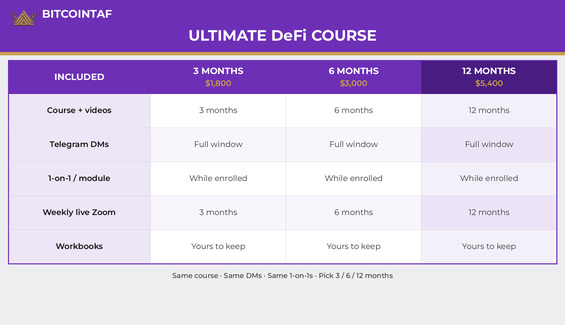
1. 6 months access to pre-recorded coursework and all new video updates
2. 6 months access to Telegram Channel for course updates and announcements
3. 6 months access to Weekly Live Training calls through Zoom
Total 4 Reviews
lanktrading6409

Bitcoin
BitcoiNJohn

CryptoArt
This exclusive feature allows you to send gifts. Don't miss out - log in now to send gifts!
BitcoinTAF.com does not provide financial advice, manage investment funds, or engage in cryptocurrency transactions on behalf of clients. We do not handle fiat payments, convert currencies, or transfer funds to third parties or overseas. Custodial and virtual asset services, where applicable, are provided independently by UAB Star Ventures (Vilnius, Lithuania) and PaidInSatoshi Inc. (Panama), or their authorized partners.
© 2015-2026 Bitcoin Trend and Forecast, USA, South Africa (Satellite Offices)